
Markets · CFDs
Contracts for difference, clearly explained.
Market prices
CFD market references
Loading market prices…
Loading market prices…
Quotes and daily ranges supplied by TradingView. Exchange data may be delayed. Reference market prices are not QMM executable bid/ask quotes; available CFD symbols and prices are shown in MetaTrader 5.
What are CFDs?
Exposure to price, not ownership.
A CFD is an agreement to exchange the difference in an instrument's price between when a position is opened and when it is closed. If the price moves in your favour, you receive the difference; if it moves against you, you pay it.
Because CFDs are derivatives, you do not acquire the underlying asset, shareholder rights or voting rights.
Underlying markets
Categories of CFD markets
Indices
Benchmarks tracking groups of listed companies.
Commodities
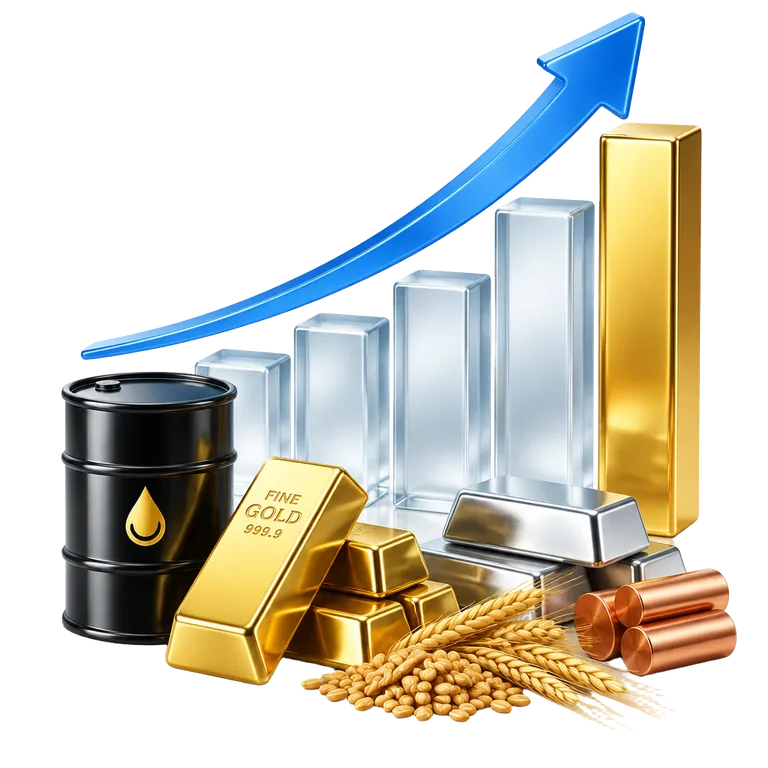
Energy and agricultural markets, where offered.
Metals
Precious metals such as gold and silver, where offered.
Shares
Individual company share CFDs, where offered.
Direction
Long and short positions
Going long (buy)
You open a buy position if you expect the price to rise. You gain if it rises and lose if it falls.
Going short (sell)
You open a sell position if you expect the price to fall. You gain if it falls and lose if it rises.
Illustrative example
How a CFD trade might work
Position
Buy 10 index CFDs at 5,000
Margin (illustrative 5%)
10 × 5,000 × 5% = 2,500
Price rises to 5,050
+50 × 10 = +500 gain
Price falls to 4,950
−50 × 10 = −500 loss
Spreads, commission and overnight financing would further affect the result.
Margin and leverage
You deposit a fraction of the full position value as margin. Leverage amplifies both profits and losses, and losses can exceed what you expected.
Trading costs
Costs may include the spread, a commission depending on account type, and currency conversion where applicable.
Overnight financing
Positions held past the daily cut-off may be subject to a financing charge or credit, where applicable.
Risk management
- Understand margin requirements before opening a position
- Use protective orders, recognising gaps and slippage
- Limit the share of capital at risk on each trade
- Monitor open positions, especially around news events
Why trade
Why trade cfds with QMM Capitals?
Many markets
Forex, indices, metals, energy and shares from one account.
Long or short
Take positions on rising or falling prices.
No ownership
Trade price movements without holding the underlying asset.
Risk tools
Use stop-loss and take-profit orders in MetaTrader 5.
Do I own the asset when trading a CFD?
No. A CFD is a derivative contract based on price; you do not own the underlying asset.
Can I lose more than my deposit?
Leveraged trading can lead to rapid losses. Whether losses can exceed your deposit depends on the terms of your account — please review our Terms and Risk Disclosure.
Are CFDs suitable for everyone?
No. CFDs are complex and high risk and are only suitable for people who understand and can bear the risks.
What is a margin call?
A notice that your equity has fallen below required levels. Positions may be closed automatically if margin is not restored.
Start trading in minutes.
Sign up online, verify your identity and fund your account to access MetaTrader 5. QMM L.L.C. is registered with the UAE SCA. Eligibility and approval requirements apply.